
Introduction
In 2025, a movement began to emerge around an often forgotten underwater world: the Dogger Bank, a shallow sandbank of over 25,000 km² in the middle of the North Sea, an area nearly the size of Belgium. Its riches are to be found both above and beneath the waves: fish like sharks, rays, cod, herring, as well as whales and seabirds. However, its ecological health has been severely degraded.
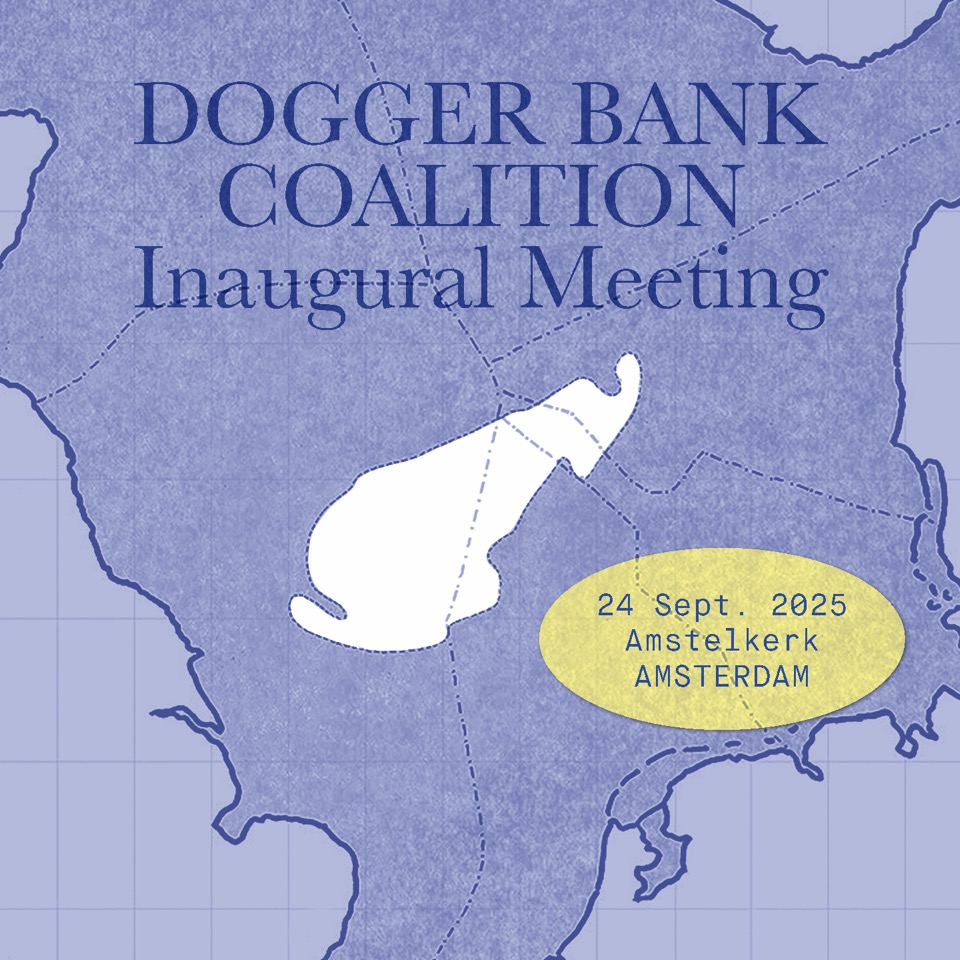
On 24 September 2025, the Dogger Bank Coalition will celebrate the launch of its European Coalition. The Embassy of the North Sea (NL), ARK Rewilding Netherlands (NL), Blue Marine Foundation (UK), Bund für Umwelt und Naturschutz Deutschland e.V (BUND, DE), Doggerland Foundation (NL), and WWF (DK) will work with many other partners over the coming years to help reestablish a thriving, abundant and resilient Dogger Bank. We will do this through (reef) restoration, legal action, research, imagination and a broad public debate about the potential and desirable futures of the North Sea.
We, the members of the coalition, invite you to sign the founding declaration of the Dogger Bank Coalition.
What does your signature mean?
By signing this declaration, in a personal capacity and/or on behalf of an organisation, you express your support for (part of) the four statements of the Dogger Bank Coalition. At the end of this document, under the heading ‘Signature,’ you can indicate whether you are signing personally and/or on behalf of an organisation.
In the coming years, we will engage in dialogues with citizens and governments in the four Dogger Bank countries about our goals. During campaigns and public programmes, we will invite many others to sign the declaration. Growing support could make a different future for the Dogger Bank a reality.
- Worldview: Dogger Bank belongs to itself
Introduction
The Dogger Bank symbolises our current relationship with the North Sea: we do not just use it, we exploit it. The dominant Western worldview sees ‘nature’ as separate from humans, as a resource. Existing North Sea policy reflects this fundamental stance, which forms an obstacle to a thriving and resilient Dogger Bank. It will only become possible to make a significant contribution to reestablishing life when we question the destructive aspects of our worldview. We are therefore creating space for a worldview in which the Dogger Bank belongs to itself and can participate independently in political negotiations. This calls for research and imagination in culture, language, law, politics and science. We are working on this via the School of Dogger Bank and public campaigns.
Statement
I endorse the importance of imagining and exploring a world in which the North Sea and Dogger Bank are seen as of their own, as living systems with intrinsic value and the right to effective representation.
[yes / no]
- More North Sea democracy
Introduction
In current North Sea politics, the participation of a vibrant civil society, democratic debate, vision and ecological ambition are not sufficient. The North Sea is parcelled up as if it was a large industrial area. North Sea policy is centred on economic interests and dominated by a technocratic approach. The danger of too much technocracy is the lack of democracy. North Sea politics is the concern of a small group of experts and stakeholders; not the wider public and the North Sea community.
Statement
I endorse the importance of greater public participation in North Sea politics and policies. This is a task for governments and civil society. More countervailing power and more positions are needed, in which voices and interests of minorities and future generations are also heard and represented.
[yes / no]
- Guarding the red line
Introduction
The Dogger Bank has long been protected on paper as an important breeding area and feeding ground under the Natura 2000 network. However, in reality the underwater world hardly enjoys any protection as many types of harmful activities continue to be allowed and still take place. The Dogger Bank is severely degraded. Regarding Dogger Bank, Denmark, Germany, The Netherlands and the United Kingdom have set their biodiversity objectives at an unambitious level. And even these targets designed to safeguard the ecological bare minimum are not being met. For this reason, we have started legal proceedings to ensure that governments comply with their own laws and regulations and, at the very minimum, implement the most basic protective measures in marine protected areas like the Dogger Bank that can enable a form of recovery to a more favourable status.
Statement
I agree that states must comply with national and international laws and regulations to ensure the effective protection and restoration of North Sea ecosystems, and therewith the Dogger Bank.
[yes / no]
- Restoration
Introduction
It is important to give the Dogger Bank a long period of rest so that the ecosystem can recover on its own. But that is not enough. In addition to passive protection and recovery, it is necessary to actively restore species, habitats and ecological processes that are degraded to the point that they cannot recover on their own. These natural processes need a ‘kickstart’ before the ecosystem can take over once again. In response, the coalition launched a large-scale restoration programme called ‘Rewilding Dogger Bank’, with a central role for horse mussels that are an essential part of a healthy seabed and rich biodiversity on the Dogger Bank.
Statement
I express [on behalf of my organisation] support for the initiative to restore the Dogger Bank ecosystem.
[yes / no]
Signature
Name …………………………………………
I sign in a personal capacity [yes / no]
On behalf of organisation …………………………………………
Signature …………………………………………
Would you like to receive the newsletter? [yes / no]
May we include your personal statements of support on our websites? [yes / no]
May we refer to the statements you support on behalf of your organisation on our websites? [yes / no]
